
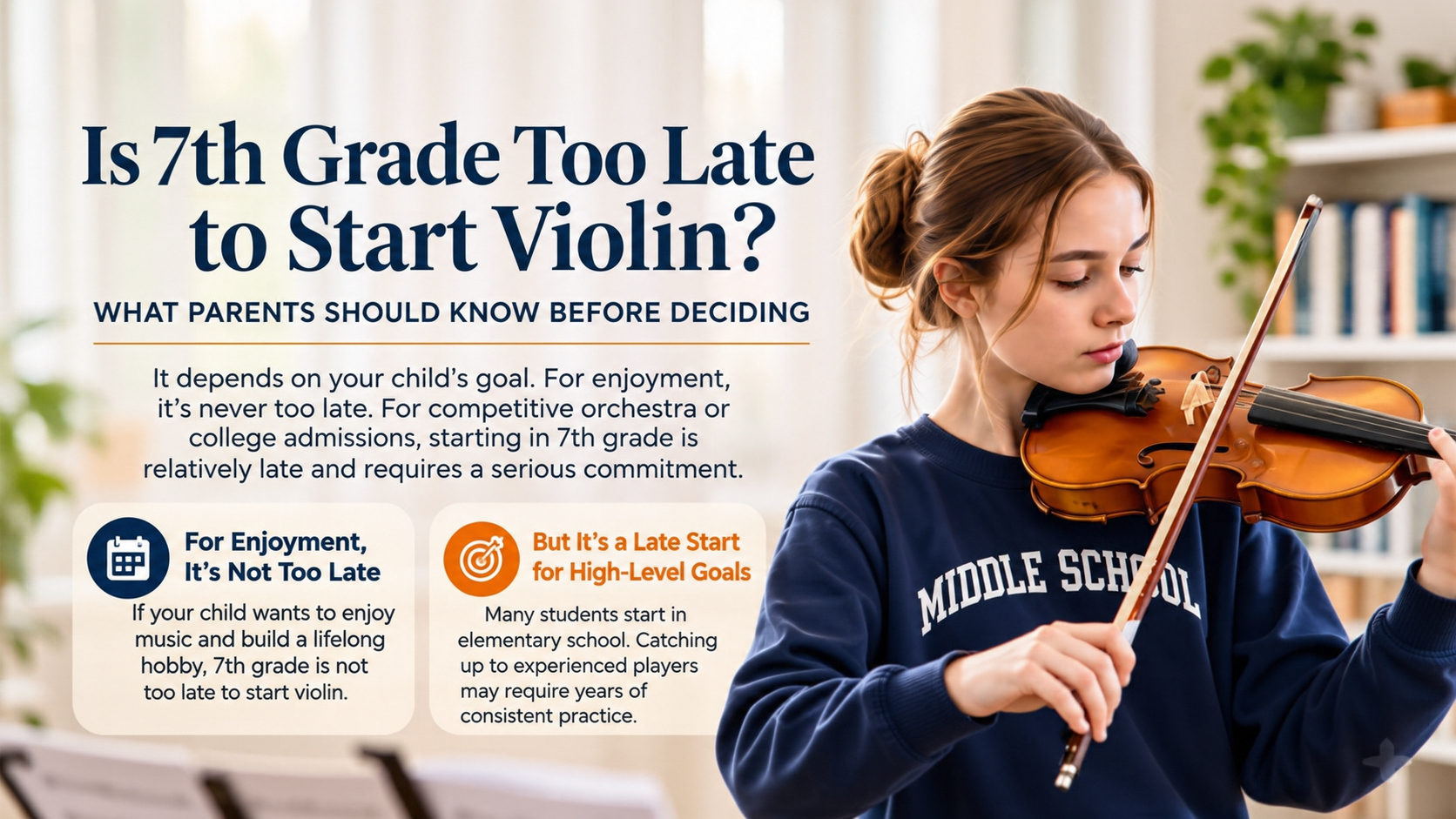
When a child suddenly becomes interested in violin in middle school, parents may wonder:
Is 7th grade too late to start?
My answer is: It depends on the goal.
If your child simply wants to learn violin for enjoyment, it is certainly not too late. Music can become a wonderful lifelong hobby at almost any age.
But if the goal is to catch up quickly with experienced players, earn a high position in a strong school orchestra, or eventually use violin as a significant part of a college application, I would look at the situation much more realistically.
For those goals, starting violin in 7th grade is relatively late.
Table of Contents
Many Violin Students Have Already Been Playing for Years
Many children who are serious about violin begin in elementary school, sometimes as early as first or second grade.
By the time they reach middle school, some students already have several years of private lessons, orchestra experience, recitals, and competitions behind them.
A 7th-grade beginner is not just learning how to read notes.
They need to develop bow control, intonation, posture, rhythm, sight-reading, ensemble skills, and eventually more advanced techniques.
None of this means a late beginner cannot become a good violinist.
There are certainly students who start in 6th or 7th grade and make impressive progress.
But I would not assume that catching up will be easy.
If a child wants to close a several-year gap, consistent daily practice and good private instruction may be necessary. Depending on the level they hope to reach, music could require a significant amount of their available time.
That is something families should consider before committing.
Choosing the right music teacher is also important, especially for students who begin violin in middle school and need clear guidance and encouragement.
Previous Piano Experience Can Make a Big Difference
One exception I would look at differently is a child who has already studied piano for several years.
A strong piano background can provide a valuable musical foundation.
The child may already know how to read music, understand rhythm and key signatures, recognize pitch, and follow musical phrasing.
Violin technique is completely different, of course. Learning to use the bow and play in tune without fixed keys still takes considerable work.
But musically, that child is not beginning from zero.
In some cases, a child with years of piano experience may progress through the early stages of violin much faster than a student with no previous musical training.
If a child already enjoys piano, however, I would also ask another question:
Do they really need to switch?
Sometimes continuing to develop an instrument they already play well may make more sense than starting over with a completely new instrument.
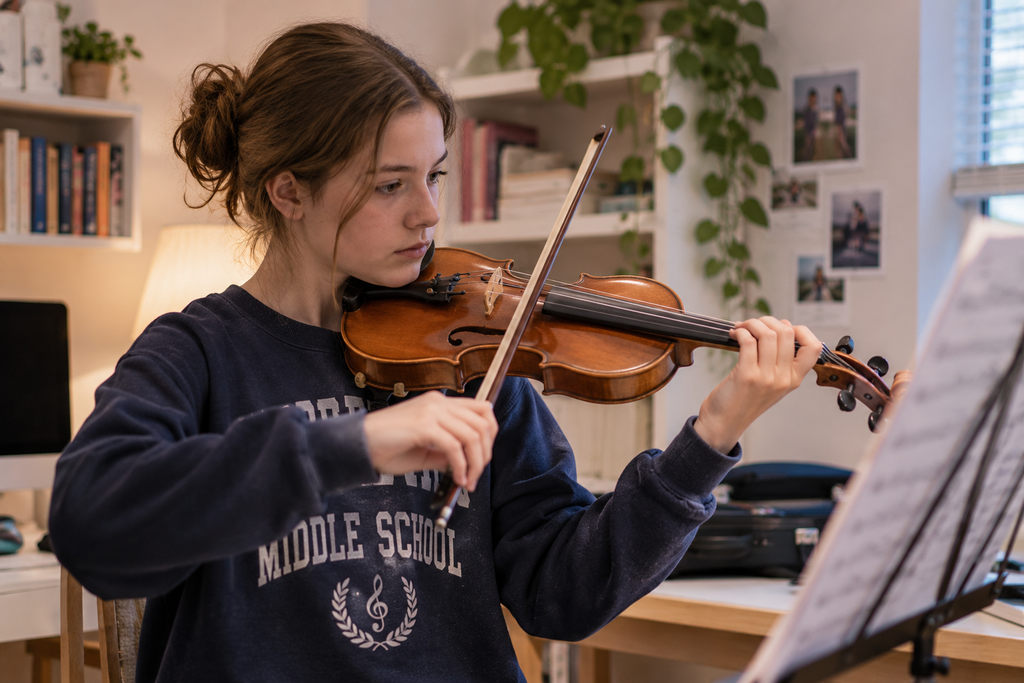
Starting Violin in 7th Grade: Check Your School Orchestra First
This is one of the most important things parents can do.
The level of school orchestras varies tremendously from one school district to another.
Some middle schools have beginning orchestra classes where a 7th-grade beginner can fit in comfortably.
Other schools have students who have taken private lessons for years and may have highly developed orchestra programs that continue into competitive high school ensembles.
Some students may also participate in outside youth orchestras in addition to their school programs.
Parents can also explore music education resources from the National Association for Music Education (NAfME) when considering school music programs.
Before buying a violin or committing to lessons, I would contact the school orchestra director and ask:
Does the orchestra accept beginners in 7th grade?
Is there a separate beginning orchestra?
Is an audition required?
What playing level is expected?
What level do students typically reach by high school?
Are there particular instruments the orchestra currently needs?
Those answers matter much more than a general rule about what age is “too late.”
If Orchestra Is the Goal, Consider More Than Violin
If the main goal is to participate in an ensemble, I would not automatically choose violin.
Violin is extremely popular, and some school or youth orchestra environments can have many violinists competing for positions.
Depending on the particular program, it may be worth asking about viola or cello as well.
Some violin students even move to viola later because their ensemble needs violists or because it offers them a different musical opportunity.
A school band can also be worth considering.
If a middle school student wants the experience of performing in an ensemble but has not yet committed to a specific instrument, I would talk with the school’s music director before deciding.
The best choice depends on the child and the actual needs and structure of the school’s music program—not simply on which instrument seems easiest to enter.
Think Carefully If the Goal Is College Admissions
This is the part where I would be especially cautious.
If a child genuinely wants to play violin, that is a meaningful reason to start.
But if the main reason for starting in 7th grade is:
“Orchestra will look good on a college application,”
I would think twice.
Simply participating in school orchestra does not automatically create a standout college résumé.
And violin, cello, and piano already have many students who have been studying seriously for years.
For a late beginner to reach a highly competitive level can require a great deal of practice time, private lessons, and commitment.
By high school, that time becomes even more valuable.
Academic workloads increase. Children may have sports, clubs, volunteering, competitions, and other interests. And adolescence itself can make maintaining the same practice schedule much harder.
If the child doesn’t genuinely want to learn a string instrument, I would not invest years of valuable time simply because it might look good for college.
There may be another activity the child already enjoys and does well that deserves that time instead.
Be Realistic About the Time Commitment
A motivated middle school beginner can make significant progress.
But catching up to students who have been playing for five or six years is a very different goal from simply becoming a competent player.
A student trying to close that gap may need substantial daily practice in addition to private lessons and school orchestra rehearsals.
Before starting, I would ask:
Does my child actually want to devote that much time to this instrument?
That question becomes increasingly important as high school approaches.
There are only so many hours in a child’s day.
Choosing one activity often means having less time for another.
Starting Late Isn’t Wrong—But Know Why You’re Starting
I don’t believe a child should be told, “You’re too old, so don’t even try.”
If a 7th grader hears a violin and genuinely thinks, “I want to learn that,” there can be tremendous value in letting them try.
They don’t need to become first chair.
They don’t need to win competitions.
They don’t need to turn violin into a college credential.
They can simply become someone who enjoys playing music.
But if the goal is competitive orchestra placement or building a serious music résumé, parents should understand that 7th grade is a relatively late starting point for violin and that catching up may require a major commitment of time.
In that situation, I would first look at the child’s previous musical experience, the level of the school orchestra, the amount of practice they are realistically willing to do, and whether another instrument—or an activity they already love—might be a better investment.
Starting late isn’t the same as starting wrong.
But before starting, it is worth being clear about why your child wants to play and where they hope music will take them.