
Kids grow fast.
Sometimes it feels like I just bought a new pair of pants or a nice jacket, and suddenly the sleeves are too short or the waist doesn’t fit anymore.
And when you have more than one child, getting rid of every outgrown piece of clothing doesn’t make much sense—especially when kids’ clothes can be surprisingly expensive.
Over the years, I’ve developed a simple system for our family.
Some clothes get passed down.
Some are stored because they carry memories.
Some are donated.
And some sit in the donation pile for a while—until one of my kids suddenly discovers them and says,
“Wait! I still want that!”
I’ve learned that organizing children’s clothes isn’t really about getting rid of as much as possible.
For me, it’s about deciding what is still useful, what is meaningful enough to keep, and what is ready to serve another family.
1. I Pass Down Clothes Whenever It Makes Sense
With multiple children, hand-me-downs can save a lot of money.
If a piece of clothing is still in good condition and another child can wear it, I usually keep it.
But I’ve also learned that being siblings doesn’t automatically mean the same clothes will work for every child.
Children can have different body shapes. Certain colors may look better on one child than another. Their preferences can also be completely different.
So I don’t keep something simply because another sibling might wear it someday.
I ask myself:
Is this realistically something the next child will wear?
If the answer is yes, I keep it.
If I’m already pretty sure it won’t work, there isn’t much point in storing it for several years.
Still, whenever hand-me-downs do work, I’m happy to use them.
Kids grow too quickly—and clothes cost too much—to throw away perfectly good clothing just because the first child outgrew it.
2. Clear Storage Bins Make Hand-Me-Downs Much Easier
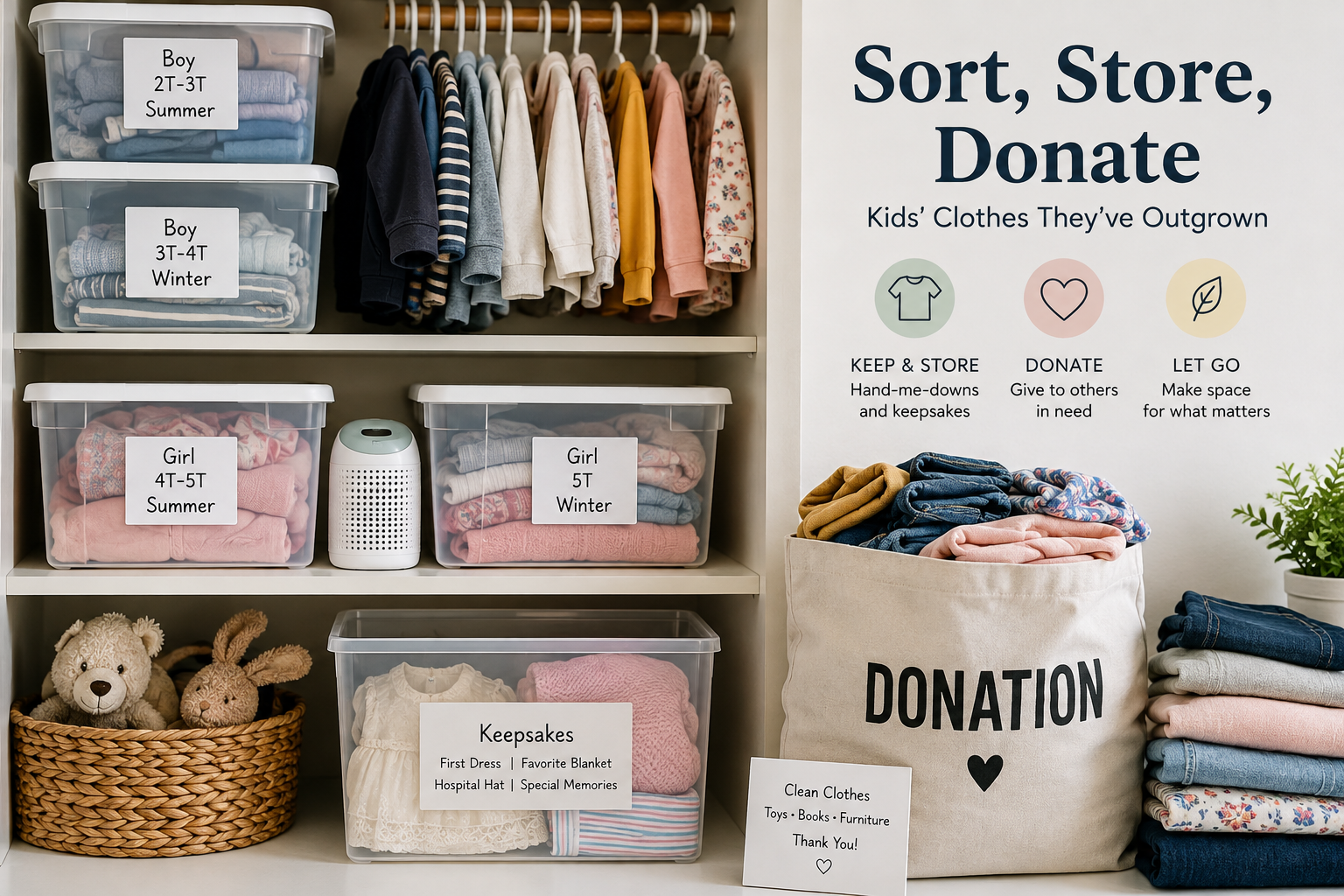
For clothes I’m saving for another child, I like using clear plastic storage bins.
Being able to see what’s inside makes a big difference.
I also label the bins so I don’t have to open several containers later just to find one particular size.
Depending on what I’m storing, the label might include the child’s name, clothing size, or season.
The important thing is that future me can understand what’s inside.
Because six months or two years later, I probably won’t remember.
Before storing clothes for a long time, I make sure they are clean and completely dry.
If I’m concerned about humidity in the storage area, I may use a moisture absorber.
For some clothing, I also use vacuum storage bags.
They reduce the amount of space bulky clothes take up, which can be especially helpful when storing things for a younger sibling who won’t need them for quite a while.
The goal isn’t to create a perfect storage system.
I just want to be able to find the clothes again when we actually need them.
3. Sentimental Clothes Have Their Own Rules
Not every piece of clothing has to pass a practical test.
Some things I keep simply because they mean something to me.
I still have a baby garment that I wore when I was little.
Because of that, I understand how an ordinary-looking piece of fabric can carry an entire memory.
With my own children, there are certain things that I don’t want to donate just because they no longer fit.
A first-birthday dress.
A favorite piece of baby clothing.
A blanket that went everywhere with a child for years.
Those aren’t really “clothes to organize” anymore.
They are keepsakes.
I store sentimental items separately in clearly labeled containers, similar to the way I store hand-me-downs.
I don’t keep everything.
If I did, I would eventually need another house just for memories!
But I also don’t believe decluttering has to mean forcing yourself to throw away everything sentimental.
Some things are worth the space they take up.
4. I Don’t Do One Huge Closet Cleanout
I’ve found that I don’t really need one enormous day devoted to organizing every child’s closet.
Instead, I deal with things gradually.
When I notice something has become too small, I take it out.
If another child can use it, it goes into storage.
If it has special meaning, it goes with the keepsakes.
If it’s still in good condition but we no longer need it, it goes into the donation pile.
Then I keep adding to that pile over time.
This works much better for me than waiting until every closet is overflowing and trying to make hundreds of decisions in one afternoon.
Little decisions are easier.
Eventually, enough things accumulate that it’s time for them to leave the house.
5. Our Neighborhood Donation Pickup Makes Donating Easy
One thing that makes this system especially convenient for our family is that our neighborhood has donation pickups every few months.
They accept things such as clothing and sometimes other household items according to the pickup instructions.
So instead of loading everything into the car and driving somewhere to donate it, I can gradually collect items at home.
When pickup time comes, I prepare and label everything as required and put it out at the designated time.
Then it’s picked up.
For me, removing that extra errand makes donating much easier.
If I had to immediately drive somewhere every time I found three shirts and a pair of pants that no longer fit, I would probably keep postponing it.
Instead, I have somewhere for those things to wait.
And once the pickup day arrives, a whole group of things can leave at once.
6. I Usually Donate Rather Than Sell Our Used Clothes
There are plenty of ways to sell children’s clothing, and I know that works very well for many families.
Personally, I’ve never felt very comfortable putting a price on our used clothes and selling them.
That’s simply my preference.
If something is still nice enough for another child to enjoy, I’d rather donate it or give it to someone I know.
Sometimes I have clothing that is barely worn—maybe something where the tag was removed but the child hardly wore it.
If I miss the neighborhood donation pickup and know someone who could use it, I’m happy to pass it along.
I like knowing that something sitting unused in our house can become useful to another family.
Interestingly, I’m completely comfortable buying secondhand items myself.
I’ve purchased things from resale sites before, and I appreciate being able to find something for less, sometimes with the ability to negotiate the price.
So I don’t think selling used clothing is wrong at all.
It’s simply not the way I personally prefer to handle our family’s outgrown clothes.
7. The Hardest Part? When the Kids Change Their Minds
This is probably the funniest—and sometimes most frustrating—part of decluttering children’s clothes.
I’ll decide:
This doesn’t fit anymore. We’re donating it.
It goes into the pile.
And suddenly a child who hasn’t worn that shirt in months becomes deeply attached to it.
“I still wear that!”
Or:
“But that has memories!”
Apparently, clothes become much more precious the moment Mom decides to give them away.
I’ve learned not to turn every piece of clothing into a battle.
Sometimes an item really does have meaning to the child that I didn’t realize.
If something is genuinely special, I’m willing to reconsider.
At the same time, we can’t keep every shirt, pair of pajamas, and jacket simply because something once happened while they were wearing it.
So we try to find a balance.
A few meaningful things can stay.
Everything doesn’t have to.
8. I Try to Separate “Useful,” “Meaningful,” and “Just Hard to Let Go”
This has probably become my simplest way of making decisions.
When I’m unsure about something, I mentally put it into one of three categories.
Useful:
Will another child realistically wear this?
Meaningful:
Does this represent a memory that we genuinely want to preserve?
Ready to go:
Is the only reason I’m keeping this that I feel bad getting rid of it?
That last category can be surprisingly large.
Maybe the clothing was expensive.
Maybe it was barely worn.
Maybe I remember how excited I was when I bought it.
But none of those things necessarily mean it needs to live in a storage bin for the next ten years.
If nobody will wear it and it isn’t truly sentimental, I’d rather let another family use it while it’s still in good condition.
9. Hand-Me-Downs Don’t Have to Feel Like Leftovers
I also think there is an important difference between passing down something useful and simply giving a younger child everything an older sibling no longer wants.
Hand-me-downs should still make sense for the child receiving them.
If something fits, looks good, and the child likes it, wonderful.
We use it.
If it doesn’t suit that child’s body, preferences, or needs, I don’t think we have to force it just because it’s free.
Saving money matters.
But children are individuals too.
The system works best for us when hand-me-downs are treated as an option—not an obligation.
A Simple System That Works for Our Family
Our system isn’t complicated.
When clothes become too small, I decide:
Pass it down. Store the memory. Donate it.
That’s basically it.
The clear bins and labels help me remember what we’ve kept.
Gradually collecting donation items means I don’t need a huge decluttering day.
And allowing ourselves to keep a small number of truly sentimental things makes it easier to let go of everything else.
Most importantly, I don’t think the goal is to have the emptiest closet possible.
Children grow.
Their bodies change.
Their tastes change.
And the clothes that once seemed so important eventually become too small.
Some will move on to a younger sibling.
Some will go to another family.
And a very small number will stay with us because they hold a piece of childhood that we’re simply not ready to give away.
For me, decluttering kids’ clothes isn’t about getting rid of memories. It’s about knowing which things are memories—and which things are simply clothes.