

“How was school today?”
“Good.”
“What did you do?”
“Nothing.”
If you are a parent, you have probably had this conversation more times than you can count.
I used to think that learning how to get your child to talk about their day simply meant asking more questions. But over time, I realized that the problem wasn’t that they didn’t want to talk. Sometimes, I simply wasn’t asking the right questions—or giving them the right space to answer.
As my children have grown, I’ve also learned that the way I communicate with an elementary school child doesn’t always work with a teenager.
What has helped our family most is surprisingly simple: asking specific questions, paying attention without immediately questioning, finding one-on-one time, and learning to listen without trying to fix everything.
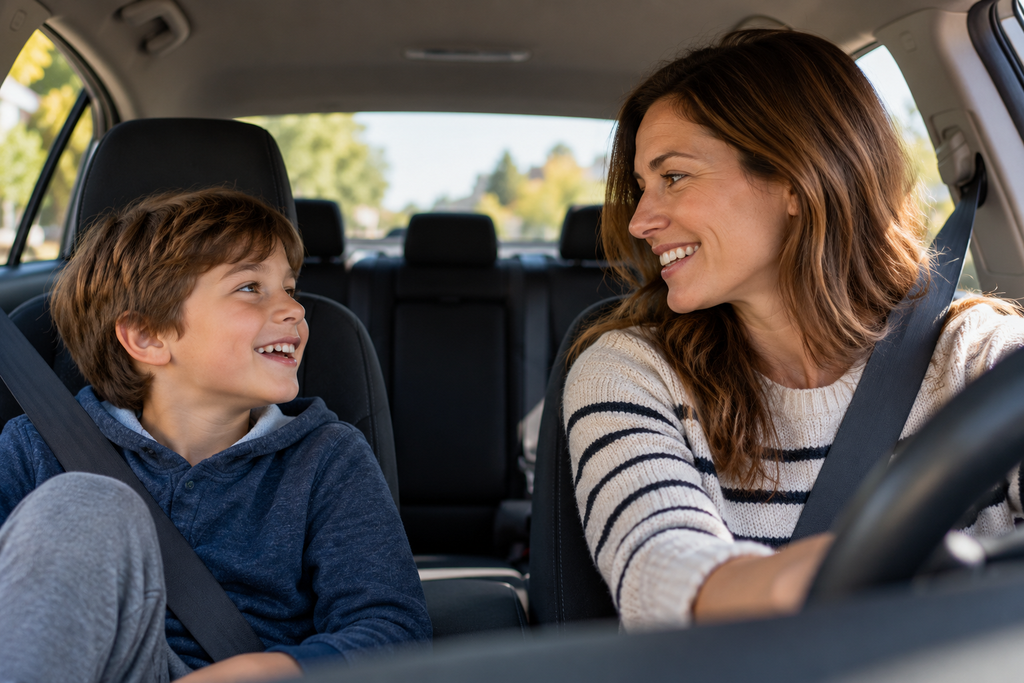
And strangely enough, some of our best conversations happen in the car.
Table of Contents
1. How to Get Your Child to Talk About Their Day: Stop Asking “How Was School?”
“How was school?” is an easy question to ask, but it is also an easy question to answer.
“Fine.”
Instead, I’ve found that asking about a specific moment of the day usually leads to a much better conversation.
I might ask:
“Who did you eat lunch with today?”
“What made you laugh the most today?”
“What did you do in PE?”
“What did your class get in trouble for today?”
These questions give children something concrete to remember.
Instead of trying to summarize six or seven hours of school, they can picture one moment.
And once they start talking about that moment, something interesting often happens.
One story leads to another.
A story about lunch becomes a story about a friend. That turns into something funny that happened in class. Then suddenly I’m hearing about the teacher, a project, recess, and something that happened three days ago.
Sometimes all they need is the right starting point.
2. Pay Attention Before Asking Questions
Children don’t always tell us when something is wrong.
Sometimes their behavior tells us first.
Maybe my child gets into the car and gives unusually short answers.
Maybe someone who normally talks nonstop suddenly becomes quiet.
Or maybe the name of a friend I used to hear about every day suddenly disappears from the conversation.
Those small changes don’t necessarily mean something serious happened, but I’ve learned to notice them.
What I try not to do is immediately start questioning.
“What happened?”
“Did someone say something to you?”
“Are you fighting with your friend?”
When children already feel upset, too many questions can make them shut down even more.
The American Academy of Pediatrics also emphasizes the importance of listening carefully to children and helping them feel heard.
Sometimes I simply let them rest.
Later, while eating dinner or having a favorite snack, I may gently start another conversation. Quite often, the story eventually comes out on its own.
I’m learning that noticing is important, but knowing when not to ask is just as important.
3. Use One-on-One Car Rides
In a family with multiple children, everyone competes for conversation.
One child starts telling a story, another interrupts, someone disagrees with what happened, and suddenly the original story is gone.
That is why I’ve come to value the times when I happen to be driving with just one child.
Those ordinary rides have become some of our best opportunities to talk.
There is no sibling interrupting.
There is no competition for attention.
And because I’m driving, we don’t have to sit across from each other making constant eye contact.
We simply look ahead and talk.
Something about that feels easier.
A ten-minute drive to a lesson or activity can sometimes tell me more about my child’s life than sitting down and saying, “We need to talk.”
4. Stop Trying to Be the Problem Solver
This was probably one of the hardest lessons for me.
When my children told me about a problem, my instinct was to investigate.
If my child said,
“My teacher got mad at me today, and it wasn’t fair.”
I might immediately respond:
“Did you do something first?”
I thought I was being reasonable. I wanted to understand both sides.
But from my child’s perspective, it could sound like I was questioning whether I believed them.
And the conversation would often end.
Over time, I started responding differently.
“That must have felt really unfair. What happened next?”
That small change made a surprisingly big difference.
Instead of immediately deciding who was right or wrong, I first acknowledged the feeling.
I’ve also learned that giving children space to work through their own problems is an important part of raising inependent kids.
And sometimes, after telling the whole story, my child would eventually say something like:
“Well… I did start messing around first.”
I didn’t have to force the truth out.
Once they felt heard, they were often able to look at their own behavior more honestly.
That taught me something important: listening first doesn’t mean agreeing with everything my child says.
It simply means giving them enough emotional space to finish the story.
5. When They Become Teenagers, the Rules Change
As children get older, communication changes.
Questions that worked perfectly well when they were younger can suddenly feel intrusive.
A middle or high school student may get into the car with a heavy expression, put on headphones, and clearly communicate one message without saying a word:
“I don’t want to talk.”
I’ve learned that this isn’t always the moment to say,
“Take your headphones off. Tell me what happened.”
Sometimes silence itself is the better conversation.
I can drive.
They can listen to music.
And I can simply be there.
Instead of asking about their mood, I might listen for a moment and casually say:
“The bass in this song is really good.”
That comment may seem insignificant, but sometimes it is a much gentler knock on the door than:
“What happened at school?”
They may answer.
They may not.
Either way, they know I’m there.
6. Food Helps More Than We Like to Admit
There is another surprisingly effective ingredient in car conversations: food.
A teenager coming out of school after a long, stressful day may be tired, hungry, and emotionally drained.
Sometimes stopping for a favorite burger or a sweet drink changes the entire atmosphere.
There is no formal “family meeting.”
No serious announcement that we need to discuss something.
We are simply sitting next to each other, eating or drinking something they enjoy, watching the road ahead.
Gradually, the tension sometimes disappears.
And then the conversation starts.
Friendships.
A difficult teacher.
Something embarrassing that happened.
School pressure.
Worries about the future.
These are conversations that might never happen if I sat across from my child at home and asked directly.
7. Protect One-on-One Time as Children Get Older
When children have siblings, private time with a parent becomes even more valuable as they grow.
A teenager may act completely different around younger siblings.
They may want to look mature, independent, and unaffected.
But when we are alone together, I sometimes get to see the younger child who is still there underneath.
The child who wants reassurance.
The child who is confused.
The child who simply wants someone completely on their side for a few minutes.
That doesn’t mean agreeing with every decision or defending every mistake.
It means listening before correcting.
There will be time for advice later.
Not every conversation needs to become a lesson.
8. Sometimes the Best Conversation Is No Conversation at All
As parents, we naturally want to know what is happening in our children’s lives.
We want to catch problems early.
We want to protect them.
And when we see that something is wrong, our instinct is often to ask more questions.
But I’m slowly learning that closeness cannot always be forced through conversation.
Sometimes connection looks like driving quietly together.
Sometimes it is sharing a snack.
Sometimes it is listening to their music even when it isn’t the music I would choose.
Sometimes it is simply letting them know that when they are ready to talk, I will listen.
The car doesn’t have to become an interrogation room.
It can become a base camp—a quiet place where our children can rest, feel safe, and talk when they are ready.
And sometimes, being a good parent in that moment simply means being a good listener behind the wheel.