
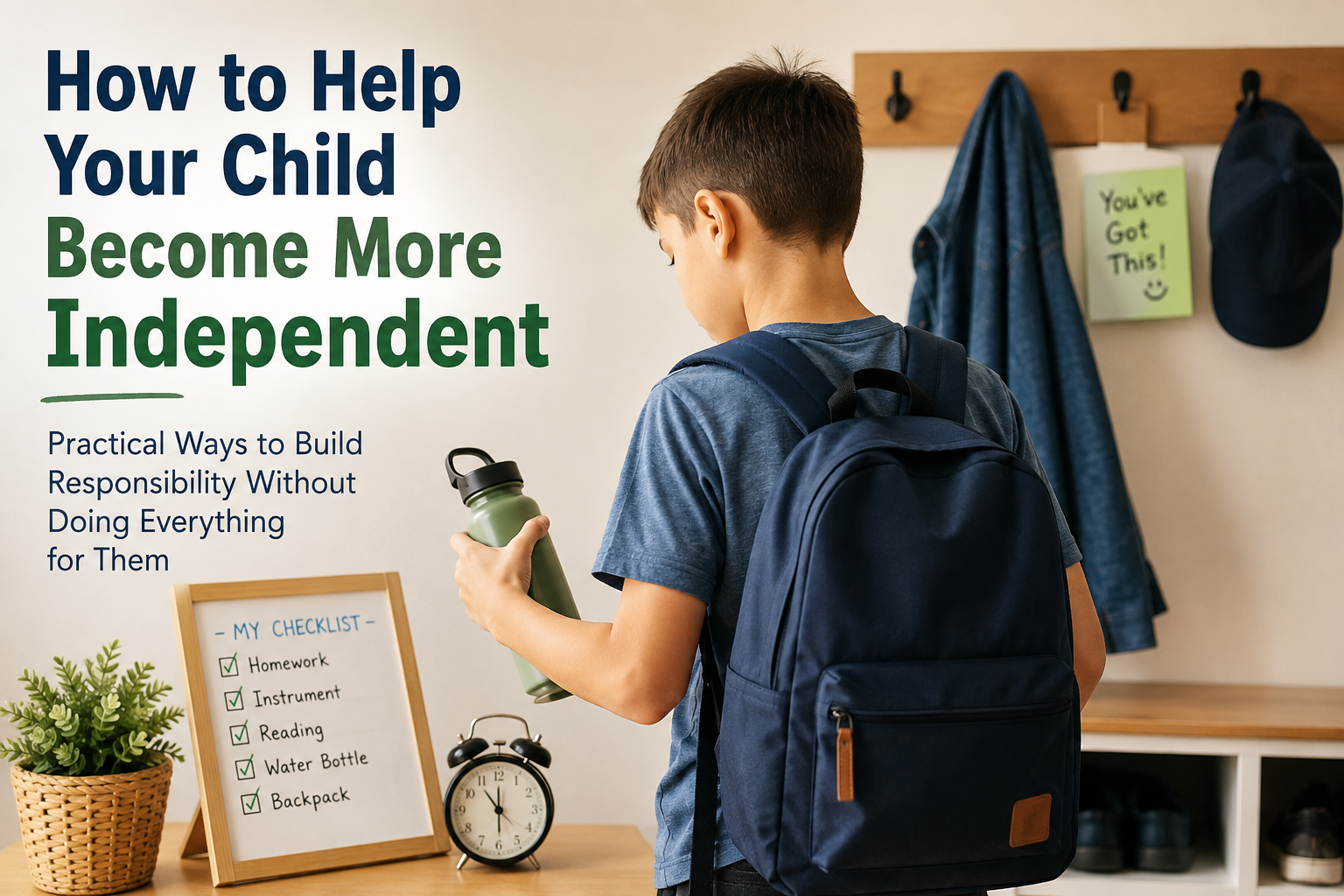
As parents, we want our children to become independent.
But in everyday life, knowing when to help and when to step back can be surprisingly difficult.
Should I remind my child about the instrument they need to bring to school? Should I drive back with something they forgot? Should I check whether an online assignment was actually submitted? Or should I let them make the mistake and deal with the consequences?
With multiple children, I have learned that independence does not happen simply because we stop helping.
It develops gradually, as we teach children what to do, give them opportunities to practice, and then slowly step back.
And perhaps most importantly, the process does not look exactly the same for every child.
Start by Teaching, Not Just Expecting
When children are younger, I think it is reasonable for parents to do more of the organizing.
For example, elementary schools often send sign-up sheets for events, donation requests, volunteer opportunities, or reminders about special items children need to bring.
At that age, parents naturally handle much of that communication.
But as children get older, I gradually expect them to remember more of what they need for their own school day.
If a teacher says they need something for class, I want them to begin thinking:
What do I need tomorrow? Where is it? When should I pack it?
That transition does not happen overnight.
At first, I may remind them. Then I might ask, “Do you have everything you need tomorrow?” Eventually, I want them to ask themselves that question without hearing my voice first.
That is the goal.
Some Things Are Worth Checking One More Time
Stepping back does not mean I never check anything.
There are situations where forgetting something has a much bigger consequence.
Musical instruments are a good example in our house.
If a child forgets an instrument, they may not be able to participate properly in a lesson or rehearsal at all. So this is something I am more likely to double-check before we leave.
I see this differently from rescuing a child from every small mistake.
Independence is not an all-or-nothing rule.
Sometimes parenting means deciding which responsibilities a child is ready to carry completely and which ones still need a little support.
Use Systems Instead of Repeating Yourself
One of the best ways I have found to reduce reminders is to create simple systems.
Laundry is one example.
Instead of repeatedly telling everyone where their clothes should go, each child can have a designated place or laundry basket. Once the system becomes familiar, less reminding is necessary.
For schoolwork, tests, unfinished assignments, practices, or other important responsibilities, alarms and calendar reminders can also help.
The point is not for Mom or Dad to become the permanent reminder system.
The goal is to teach children how to create their own reminder system.
A phone alarm can eventually replace:
“Don’t forget.”
“Did you do it?”
“Remember you have to finish that.”
That is a small but meaningful step toward independence.
Sometimes I Let Them Forget
This is probably one of the harder parts.
There have been times when the school office called because one of my children had forgotten something.
Of course, my first instinct was to bring it.
And sometimes I did.
But I also realized that if I immediately delivered every forgotten item, my children could start assuming that forgetting something was not really a problem.
Mom would fix it.
So there have also been times when I chose not to bring the forgotten item.
Not because I wanted my child to struggle, but because I knew they were capable of remembering it themselves.
A small inconvenience can sometimes teach something that ten reminders cannot.
The next time, they are much more likely to think:
I need to make sure I have that before I leave.
Help Them Solve the Problem Before Solving It for Them
Online schoolwork created another learning curve in our house.
A child might say an assignment was finished, but sometimes there was another step—actually submitting it correctly.
When that happened, simply saying, “You need to be more responsible,” was not particularly helpful.
First, we had to figure out what the problem was.
Did the child understand how to submit the assignment?
Did they think saving the work meant it had been submitted?
Was there a technical problem?
Were they rushing?
In the beginning, I might sit beside them and go through the process.
Then I would have them try it alone.
If it still did not work, we would figure out where they were getting stuck and try again.
Eventually, the responsibility became theirs.
That is the pattern I try to follow:
Do it together → Let them try → Find the problem → Teach the solution → Step back.
The last step matters.
If we keep doing something for a child long after they have learned how to do it, we may accidentally prevent the independence we are trying to build.
Don’t Expect Every Child to Need the Same Amount of Help
This has become especially clear to me while raising more than one child.
Children raised in the same house, with the same parents and many of the same rules, can be completely different.
One child may hear something once and remember it.
Another may need several reminders.
One child naturally checks everything carefully.
Another seems to live in a world where missing shoes, water bottles, homework, and schedules mysteriously appear at the last possible second.
Treating those children exactly the same does not necessarily make parenting more fair.
The destination can be the same—responsibility and independence—but the amount of guidance they need to get there may be different.
For the child who is naturally organized, I can step back sooner.
For the child who struggles to remember, I may need to help create a checklist, set an alarm, or establish a routine before stepping back.
The important part is that the support should gradually decrease as the child becomes capable.
Natural Consequences Can Be Better Than Nagging
Parents sometimes feel that allowing a child to experience a consequence means we are not helping enough.
I have come to see it differently.
If the consequence is safe and manageable, it can be part of learning.
Forgetting something, receiving a late mark, having to explain a mistake, or being temporarily inconvenienced can make a much stronger impression than hearing the same reminder every morning.
Of course, not every situation should become a lesson.
There are times when children genuinely need us to step in.
But if I know my child is capable of handling something, I try to resist fixing every small problem immediately.
There is a difference between supporting a child and removing every uncomfortable consequence from their path.
Independence Changes as Children Grow
For younger children, independence might mean:
Putting dirty clothes in the right basket, packing a backpack with help, remembering shoes and a jacket, or following a simple morning checklist.
As children get older, the responsibilities change.
They may need to manage homework deadlines, practice schedules, school materials, alarms, activities, and communication with teachers.
The parent’s role changes too.
We move from doing, to reminding, to checking occasionally, and eventually to simply being available when they genuinely need help.
That transition can be uncomfortable for parents.
Sometimes it is faster to do something ourselves.
Sometimes we know the child is about to make a mistake and desperately want to prevent it.
But children cannot practice responsibility if we never hand responsibility over to them.
The Goal Isn’t a Child Who Never Forgets
Even adults forget appointments, lose things, miss emails, and make mistakes.
So I don’t think successful parenting means raising a child who never forgets anything.
I would rather raise a child who knows what to do after forgetting.
Can they admit the mistake?
Can they figure out how to fix it?
Can they create a system so it is less likely to happen again?
Can they ask for help appropriately when they truly need it?
Those skills will matter long after homework, music lessons, and school backpacks are gone.
Final Thoughts
Helping children become independent requires a strange balance.
We have to be close enough to teach them, but eventually brave enough to step back.
Sometimes I remind.
Sometimes I check.
Sometimes I help.
And sometimes—even when I could easily fix the problem—I let my child handle it.
I don’t always get that balance right.
But I keep coming back to one idea:
Independence doesn’t mean parents stop helping. It means knowing when to help, when to teach, and when to step back.
Our children may still forget things along the way.
That’s okay.
The goal is not to make sure they never stumble.
It is to make sure that, little by little, they learn how to get back up without always needing us to do it for them.