
When my kids were very young, keeping their clothes organized was actually pretty easy.
I folded everything neatly, put it in the drawer, and—surprisingly—it stayed that way.
Of course it did.
I was the one taking the clothes out, and I was usually the one putting them back.
Then my kids got old enough to choose and dress themselves.
That was when my beautifully folded drawers started to disappear.
A child would pull out one shirt from the middle of a perfectly folded stack, and somehow everything around it would come out too. And once the drawer was already messy, there wasn’t much motivation to fix it.
Sometimes the mess even became part of the fun.
Clothes would get pulled out, tossed around, and suddenly the neatly organized drawer I had spent time arranging looked like I had never touched it.
After repeating this cycle enough times, I finally realized something:
The best way to organize kids’ clothes isn’t necessarily the prettiest way. It’s the system that your kids can actually use on their own.
With three kids, I’ve gradually stopped trying to keep every drawer perfectly folded and started organizing their clothes in ways that require less work from me—and make it easier for them to find what they need.
Here’s what has actually worked for us.
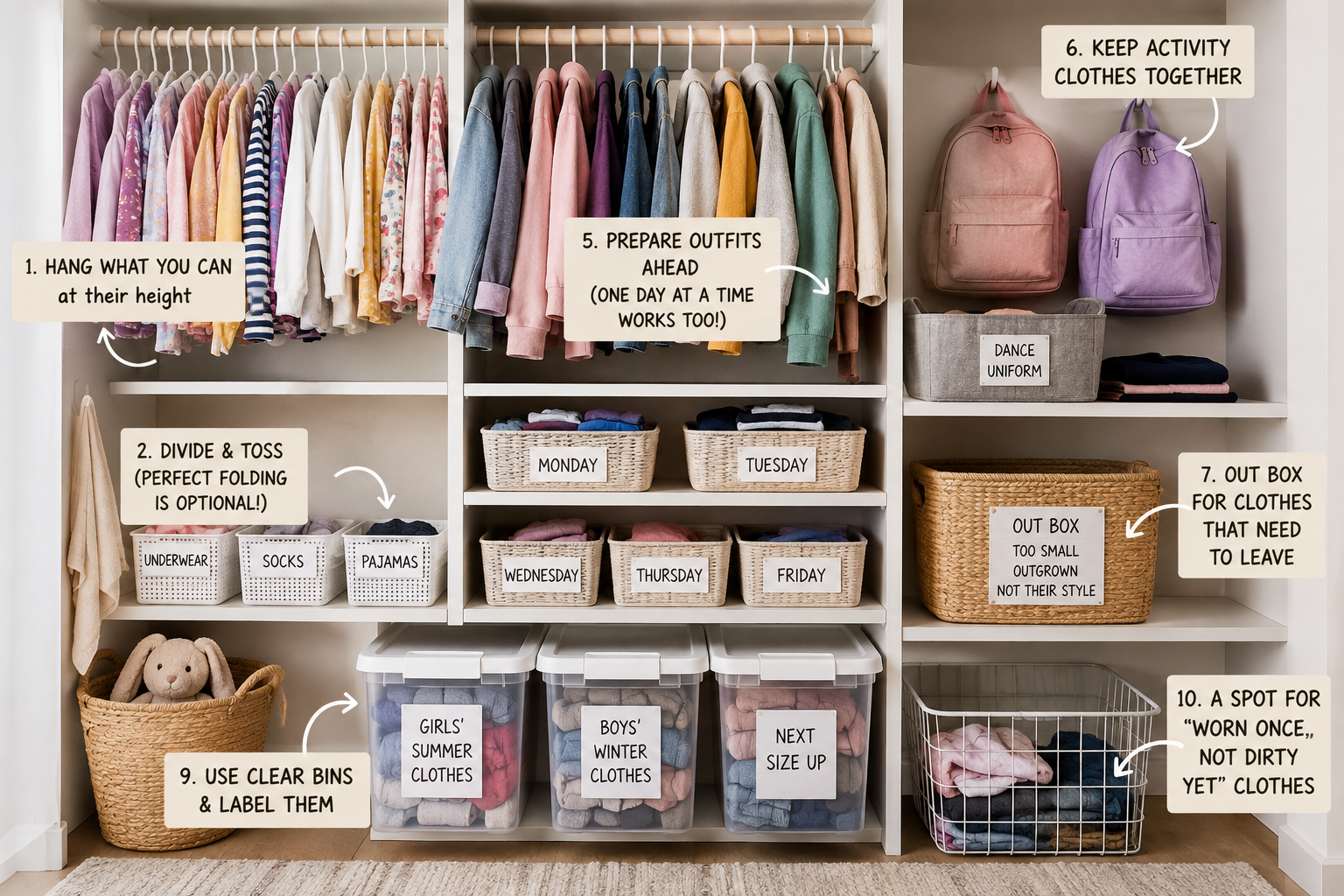
1. I Hang as Much as I Can
For shirts, jackets, dresses, and other clothes that can easily go on a hanger, I prefer hanging them.
The important part is making sure the hanging space is at a height the child can actually reach.
When clothes are hanging where kids can see them, they don’t have to dig through piles to find the shirt or dress they want.
They can look, choose, pull it off the hanger, and get dressed.
That alone prevents a lot of the mess that happens when kids start searching through drawers.
It also makes putting clothes away more straightforward.
I used to think folding everything neatly was the more organized choice. Now I think accessibility matters more.
If my child can see the clothes and reach them without my help, the system is doing its job.
2. I Stopped Trying to Fold Underwear and Socks Perfectly
Underwear, socks, pajamas, and similar basics don’t need to look like they belong in a store display.
At least not in our house.
I use divided drawers, small baskets, or separate sections and loosely fold—or sometimes simply toss—the items into the correct place.
And I’m completely fine with that.
Underwear especially doesn’t always stay nicely folded anyway. Many pieces are soft cotton or stretchy blends, and even when I carefully fold them, they tend to unfold as soon as someone starts looking through the drawer.
So why spend so much time making every piece perfect?
A quick fold and toss into the right section works just fine.
There are some battles worth fighting as a parent.
Perfectly folded underwear is not one of mine.
3. I Buy Simple Socks to Avoid the Matching-Sock Problem
This is such a small thing, but it can save a surprising amount of time.
Instead of buying lots of socks with completely different patterns, colors, and characters, I like buying several pairs of the same or very similar socks.
Then I don’t have to spend time hunting for one specific missing sock.
If one disappears—and somehow one always does—there are still several others that match.
Of course, kids can still have fun socks they love. But for everyday socks, having several identical pairs makes laundry and morning routines much easier.
Sometimes organization isn’t about finding a better storage container.
Sometimes it’s about having fewer things that need organizing in the first place.
4. For Younger Kids, I Make Clothes Easy to Mix and Match
When kids are young and still need a lot of help getting dressed, coordinating outfits every morning can become another little decision parents have to make.
Does this shirt match these pants?
Would the other color look better?
Where is the matching bottom for this top?
I try to reduce those decisions by buying everyday clothes that work well together.
For pajamas, play clothes, and basic everyday outfits, I like colors and styles that can be mixed and matched without much thought.
Then if a child chooses one top and a different pair of bottoms, there’s a good chance they’ll still look fine together.
It doesn’t have to be a perfect matching set.
For me, the goal is simply to make getting dressed easier.
5. For Older Kids, I Prepare Outfits Ahead When It Matters
Once kids reach elementary or middle school, clothes can become much more important to them.
They may care about trends, colors, how different pieces look together, or simply how they feel in a particular outfit.
At this age, I don’t want to choose everything for them.
But I also don’t want every school morning to begin with:
“What am I going to wear?”
Ideally, having Monday-through-Friday outfits prepared ahead of time would be wonderful.
Realistically?
That doesn’t always happen in our house.
What does help is choosing an outfit the night before, especially when there is a school event or something special happening the next day.
We can hang the complete outfit together or place it in one designated spot.
Then the next morning, there’s no digging through the closet, trying on three different shirts, or deciding at the last minute that nothing looks right.
Even preparing one day ahead can make mornings much calmer.
6. Activity Clothes Get Their Own Space
School PE clothes, music-related items, dance clothes, sports uniforms, and other special activity clothing can easily disappear into regular laundry and drawers.
Then, of course, you discover that something is missing exactly when you’re supposed to leave.
I prefer keeping these items together in their own bag, drawer, basket, or designated section.
The exact system doesn’t matter as much as having one predictable place for them.
If everything needed for an activity stays together, kids can grab it without searching through the entire house.
And parents don’t have to become the family search-and-rescue team every time it’s time to leave.
7. I Keep an “Out Box” for Clothes That No Longer Work
This may be one of the most useful changes I’ve made.
I keep a basket or designated space for clothes that need to leave the regular rotation.
I think of it as our Out Box.
If I notice while my child is getting dressed that something has become too small, uncomfortable, itchy, or simply something they refuse to wear anymore, it goes directly into the Out Box.
I try not to put it back in the drawer and tell myself:
“I’ll deal with it later.”
Because if I put it back, there’s a very good chance we’ll pull out that exact same shirt a few days later and have the exact same conversation again.
The Out Box gives those clothes somewhere to go immediately.
Once it fills up, I can decide what should be saved, passed down, donated, or discarded.
8. We Pass Down What We Can—and Donate Most of the Rest
We’ve been lucky because my younger daughter actually enjoys receiving clothes that her older sister has outgrown.
That makes hand-me-downs much easier.
If something is still in good condition and I think it will work for her, I save it.
But hand-me-downs don’t always work as perfectly as we imagine they will.
Kids can have different body types even when they’re siblings. Sometimes a season passes before the younger child reaches the right size. And sometimes a style that one child loved simply doesn’t work for another.
So I don’t try to save everything.
The clothes we aren’t going to use are usually donated.
I personally don’t sell our kids’ used clothes. Selling can certainly work for other families, but for me, donating them is simpler and gets them out of the house faster.
And when you’re organizing clothes for three growing kids, getting things out is just as important as organizing what stays.
9. I Use Clear Bins for Clothes We’re Saving
For clothes that will be passed down or saved for another season, I prefer clear storage bins.
I also label them clearly.
For example:
Girls’ Summer Clothes
Boys’ Winter Clothes
Next Size Up
The labels are helpful, but the clear container makes an even bigger difference for me.
If I put clothes into an opaque box and store it away for months, there’s a very good chance I’ll completely forget what is inside.
Then later I have to open every box just to figure out what I saved.
With clear bins, I can get an idea of what’s inside before opening the lid.
That makes it much easier when the seasons change or when I’m checking whether there’s something worth passing down to another child.
10. I Have a Place for the “I Wore It, But It’s Not Dirty” Clothes
This is one of those clothing problems that doesn’t fit neatly into either the closet or the laundry basket.
A child wears a jacket, sweater, jeans, or other outer clothing for a short time.
It isn’t really clean anymore.
But it definitely isn’t dirty enough to wash.
So where does it go?
Without a designated place, it usually ends up on a chair.
Or the bed.
Or the floor.
And then more clothes join it.
I like having a separate basket or a few hooks specifically for these clothes.
The child knows, “I wore this, but I can wear it again,” and there’s an actual place to put it.
It’s a very simple system, but it helps prevent that mysterious mountain of clothes from growing on the bedroom chair.
11. I Don’t Try to Make Their Closets Look Perfect Anymore
There are so many beautiful pictures of children’s closets with perfectly folded clothes, matching hangers, coordinated baskets, and drawers where every little item seems to have its own exact place.
They’re lovely.
But I’ve learned that a system can look beautiful and still not work very well for the people actually using it.
My kids need to be able to pull out their own clothes.
They need to know where things belong.
And, most importantly, putting something away needs to be easy enough that there’s at least a reasonable chance they’ll actually do it.
That means some clothes are hung.
Some are loosely folded.
Some are tossed into divided baskets.
And sometimes the drawers still get messy.
That’s okay.
I would rather have a slightly imperfect system my kids can use than a perfect system that requires me to reorganize it every weekend.
The Best Way to Organize Kids’ Clothes Is the Way They Can Maintain
After organizing clothes through different stages of raising three kids, I’ve realized that my goal has changed.
When they were little, I could control exactly how everything looked.
As they grew and started dressing themselves, that became unrealistic—and honestly, unnecessary.
Now my goal is much simpler:
Make it easy for the kids to see their clothes, choose what they need, and put things back without needing Mom or Dad every time.
Hang what makes sense.
Don’t waste time perfectly folding things that won’t stay folded.
Keep activity clothes together.
Give outgrown clothes somewhere to go immediately.
Use clear bins for what you’re saving.
And create a spot for those clothes that have been worn once but aren’t ready for the laundry yet.
For our family, organizing kids’ clothes isn’t about keeping everything picture-perfect.
It’s about creating a system that requires less work from the parents and makes it easier for the kids to take care of their own things.
The same idea works for more than just clothes. I use a similar keep-it-simple approach for all the school papers my kids bring home, too.
And even with a good system?
It’s still not always easy.
But at least I’m no longer spending my weekends trying to make every drawer look perfect again.