
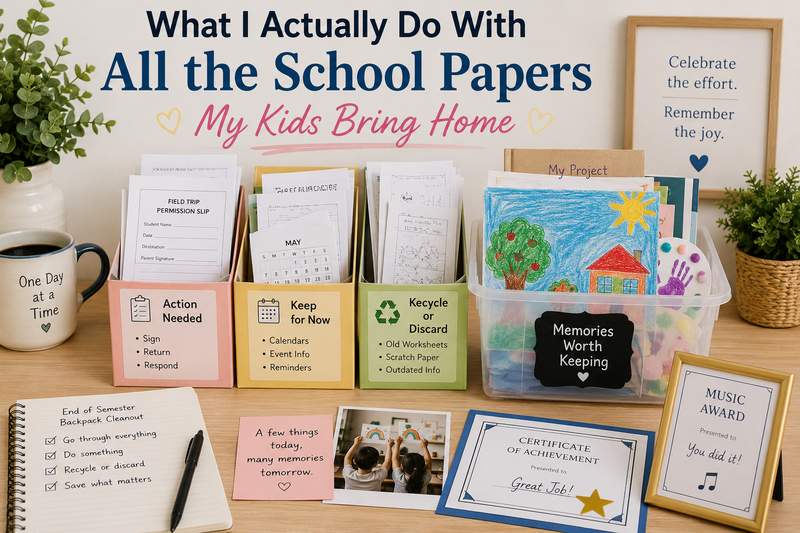
School papers have a way of multiplying.
Permission slips, event flyers, photo order forms, book fair information, practice worksheets, old homework, notebooks, school calendars—the list seems endless.
In theory, it would be wonderful if every child came home, opened their backpack, took out every piece of paper, and neatly sorted everything before the next school day.
In reality?
That doesn’t always happen.
Most days, backpacks simply go back and forth between home and school.
And honestly, once children get older and manage more of their own school life, I don’t think every parent needs to empty every backpack every afternoon.
What matters more to me is catching the papers that actually require action, letting go of the ones that no longer matter, and saving the few things that may become meaningful memories later.
Over time, this is the simple system that has worked for our family.
Not Every School Paper Deserves the Same Attention
The first thing I’ve learned is that school papers fall into very different categories.
Some need action.
Some are useful for a short time.
Some are already outdated by the time I find them.
And a few are worth keeping for years.
Treating every piece of paper as equally important creates unnecessary clutter.
So when papers come home, I mentally sort them into three basic groups:
Do something with it.
Recycle or discard it.
Save it.
That simple distinction makes everything easier.
1. Papers That Require Action Come First
Certain school papers cannot disappear into the bottom of a backpack.
Field trip permission slips are an obvious example.
There may also be forms that require a parent’s signature, school photo order forms, event information, book fair notices, or papers with an important deadline.
If I know something like that is coming, that is when I’m much more likely to ask my child to open the backpack and find it.
The important part isn’t necessarily keeping the backpack perfectly organized.
It is recognizing the papers that have a consequence if we miss them.
If a permission slip needs to be returned by Friday, that piece of paper matters very differently from a spelling worksheet from three weeks ago.
So when something requires a signature, payment, decision, or date on the calendar, I try to deal with it as soon as I see it.
Otherwise, it is far too easy to think,
“I’ll take care of that later.”
And then later becomes next week.
2. I Don’t Expect Backpacks to Be Perfectly Clean During the School Year
This may not be the most organized thing to admit, but it is realistic.
During a busy semester, backpacks can collect things.
Old worksheets.
Notebook paper.
Scratch paper.
Completed assignments.
Flyers for events that already happened.
Sometimes things stay in there much longer than anyone intended.
And unless there is a reason to go through the backpack, it may continue traveling back and forth to school exactly like that.
I don’t think that automatically means something has gone terribly wrong.
Of course, children should gradually learn to manage their own belongings.
But I also don’t expect every backpack to look perfectly organized throughout the entire school year.
Sometimes we are simply trying to get everyone to school, complete the important work, attend activities, and make it through the week.
Perfect backpack organization is not always at the top of the list.
3. The Big Cleanout Usually Happens Around a School Break
One time when I do tend to look more closely is around the end of a semester or before a new school term begins.
That is when the backpack finally gets emptied.
And somehow, an entire school term can come out of one bag.
Old notebooks.
Class notes.
Completed homework.
Worksheets.
Papers that were useful months ago.
Sometimes even a book that everyone forgot was still in there.
At that point, I don’t spend a lot of time debating every ordinary paper.
If it is no longer needed and it is recyclable paper, it goes into our recycling.
If it isn’t something we need to keep or recycle, we dispose of it appropriately.
I don’t feel a need to preserve stacks of ordinary worksheets simply because my child once completed them.
They served their purpose.
Now they can go.
4. Schoolwork Doesn’t Automatically Become a Memory
This is an area where I think it is easy for parents to keep too much.
A worksheet may represent something our child learned, but that doesn’t mean we need to keep every worksheet.
The same goes for old notebooks, vocabulary practice, scratch work, or everyday assignments.
If a child completed hundreds of papers during one school year, saving all of them would quickly become overwhelming.
So I try to distinguish between schoolwork and something meaningful from school.
A routine math worksheet?
Probably not a keepsake.
An ordinary spelling practice page?
Probably not.
But a piece of writing that shows something special about my child, a project they were especially proud of, or an artwork that immediately brings back a memory?
That may be different.
5. Each Child Has a Memory Bin
For the things that really do matter, each child has a separate memory storage bin.
I like having one designated place because it gives sentimental items a boundary.
When something feels special, it doesn’t have to sit on a counter for six months because I don’t know what to do with it.
It has a home.
That might include a special piece of school artwork, a meaningful project, something the child is especially proud of, or another item they genuinely want to remember.
But the memory bin isn’t meant to hold everything the child has ever touched.
The limited space actually helps us decide:
Is this really something we want to remember?
If the answer is yes, we keep it.
If not, we can let it go.
6. Sometimes I Save the Memory Without Saving the Object
Children’s projects can be difficult to store.
Some are large.
Some are made from materials that don’t age well.
Some eventually tear, fade, or fall apart.
And realistically, we cannot display every project our children create throughout their school years.
So sometimes I take a photo instead.
If a child created something special, I can photograph it and save the picture in Google Photos.
Then even if the original project becomes damaged later or we eventually decide we no longer have space for it, the memory is still there.
I like this because it reduces some of the guilt that can come with letting go.
We aren’t pretending the project never existed.
We are simply preserving it in a different way.
And sometimes a clear photograph is enough to bring back the entire memory years later.
7. Awards Are Different in Our House
Awards and certificates are one category I like to handle differently.
Instead of immediately placing every meaningful award into a storage box, I sometimes put it into a frame and display it.
I like the idea that children can actually see something they worked hard for.
A certificate sitting inside a plastic bin isn’t doing much for them today.
But an award hanging where they pass it regularly can remind them:
“I worked for that.”
“I accomplished something.”
For me, displaying certain achievements isn’t only about decoration.
It can be a small reminder of a good experience, a proud moment, or the effort that led to it.
Eventually, the frame can hold something new and the older item can move into the memory bin if we still want to keep it.
8. I Try Not to Save Things Only Because I Feel Guilty Throwing Them Away
This is probably one of the hardest parts of keeping children’s memories organized.
Parents can attach meaning to almost anything.
We remember the grade they were in.
The teacher.
How small their handwriting was.
The funny picture they drew in the corner.
Suddenly an ordinary worksheet feels difficult to throw away.
But if I kept something every time I felt a little sentimental, the memory bins would eventually become storage units.
So I try to ask myself:
Will we actually care about this years from now?
Not:
Do I feel slightly bad throwing this away today?
Those are very different questions.
A few carefully chosen objects usually mean more than five boxes filled with things nobody remembers keeping.
9. Let the Child Have a Voice Too
Sometimes I think something is ordinary and my child thinks it is incredibly important.
That matters.
A project may look like just cardboard, glue, and paper to me, but the child may remember exactly who they worked with, what happened that day, or how proud they felt when they presented it.
So when I am unsure, I ask.
“Do you want to keep this?”
Sometimes the answer surprises me.
Other times they look at something I was about to save and say,
“Why would I want that?”
That makes the decision very easy!
I don’t think parents have to make every memory decision alone.
Part of the process can be teaching children that we cannot keep everything—but we can choose what matters most.
10. The Goal Isn’t a Perfect Backpack
I think this is the part I want to remember most.
There are wonderful organization systems online.
Folders for every subject.
Inbox trays.
Daily backpack cleanouts.
Color-coded filing systems.
Those systems may work beautifully for some families.
But our real life doesn’t always look like that.
Sometimes the backpack is messy.
Sometimes we discover an old paper months later.
Sometimes an event flyer survives in the bottom of the bag long after the event is over.
And that’s okay.
For me, the important questions are simpler:
Did we catch the papers that needed action?
Did we let go of the things we no longer need?
Did we preserve the few things that truly matter?
If the answer is yes, I’m satisfied.
Final Thoughts
Children bring home an incredible amount of paper over the years.
We don’t need to save all of it.
And we don’t need a perfect filing system to manage it.
In our family, the process is simple.
Important forms get handled.
Ordinary school papers eventually get recycled or discarded.
Special projects go into each child’s memory bin.
Some artwork is photographed and saved digitally.
And meaningful awards sometimes go straight into a frame where the child can actually enjoy seeing them.
There will probably always be a few forgotten papers hiding at the bottom of a backpack.
That’s real life.
The goal isn’t to keep every backpack perfectly organized. It’s to catch what matters, let go of what doesn’t, and save the few things our children may want to remember someday.