
Back-to-school season always makes me feel like we have more than enough school supplies.
I buy extra pencils, glue sticks, erasers, markers, and all the other little things my kids seem to need throughout the school year.
Then somehow, when one of my kids suddenly needs a new glue stick or a pack of pencils, I go looking for the extras and think:
Wait. Didn’t I buy a whole bunch of these?
And there are only one or two left.
With three kids, I’ve learned that buying school supplies is actually the easy part.
The harder part is figuring out how to organize school supplies at home so the kids can find what they need without using—or losing—everything at once.
Over the years, I’ve tried to make our system simple.
The supplies my kids use regularly are easy for them to reach. The extra supplies are stored separately and restocked as needed.
It’s not a perfectly organized Pinterest-worthy system.
But it works for our family.
1. Our Rolling Cart Keeps Homework Supplies Where We Actually Use Them
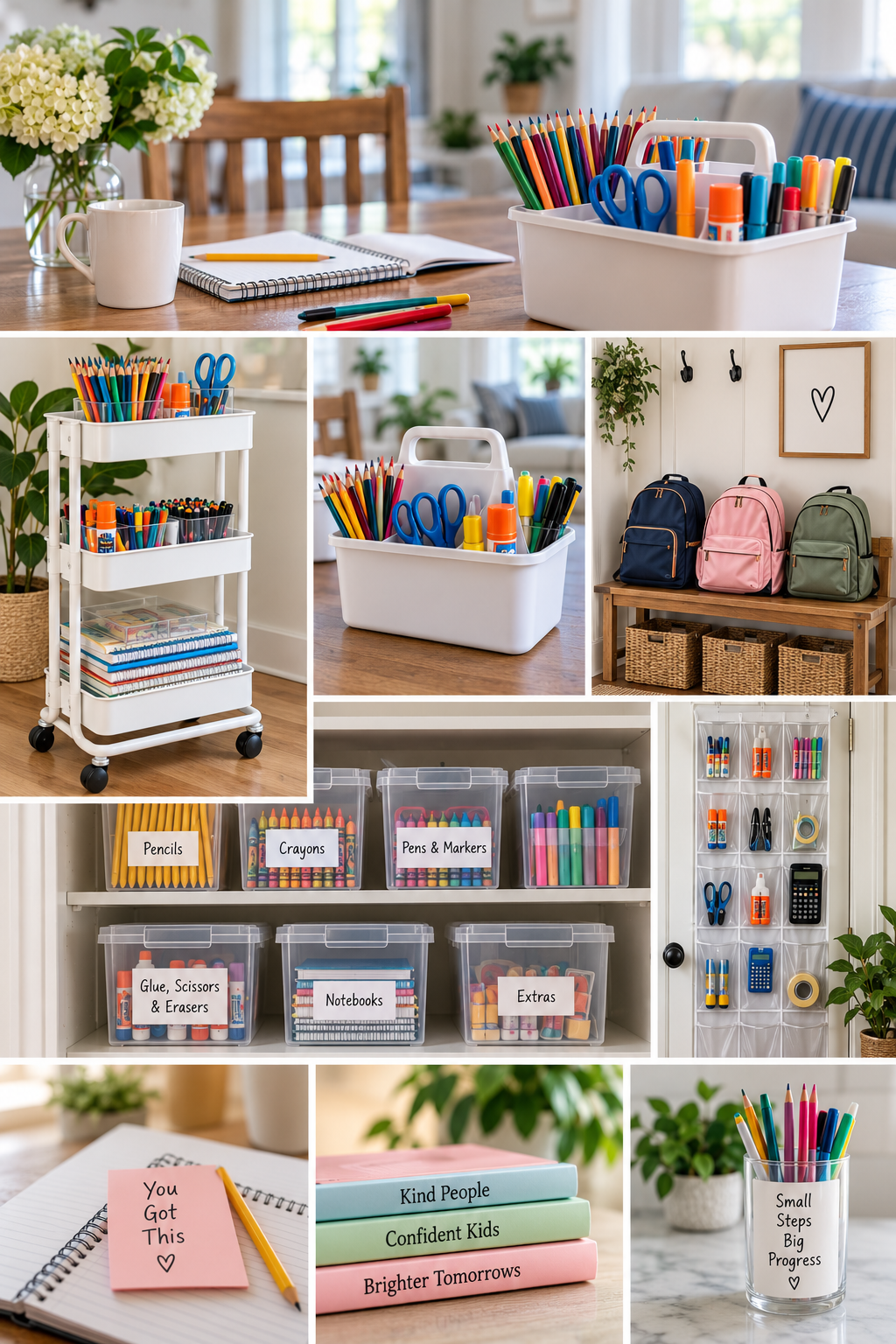
One of the most useful things in our house is a simple three-tier rolling cart.
You’ve probably seen these carts at places like Target or IKEA. They show up everywhere in home organization photos, and I understand why.
They’re especially useful if your kids don’t always do homework at a desk.
My kids have desks in their rooms, but we have learned that doing homework alone in their rooms doesn’t always work very well in our house.
They start doing homework.
Then they get distracted.
Then they procrastinate.
And somehow we’re still working on homework late at night.
So in our house, homework is usually done outside the bedrooms, at the dining table or another table in our main living area.
That’s where the rolling cart becomes so useful.
I organize ours roughly like this:
Top tier: pencils, erasers, glue sticks, and scissors
Middle tier: colored pencils and markers
Bottom tier: rulers, notebooks, and other larger supplies
When someone needs to do homework or work on a project, we can simply roll the cart over to the table.
When they’re finished, everything goes back onto the cart and the whole thing gets rolled out of the way.
It sounds simple, but it has made a big difference.
Without the cart, pencils, markers, scissors, and glue seem to slowly take over the dining table.
The rolling cart gives everything a home without forcing the kids to carry supplies back and forth from their bedrooms.
2. A Small Caddy Works for the Supplies Kids Use Most
Not every family needs a full rolling cart.
A smaller option is a plastic caddy with a handle—the kind that almost looks like a little shower caddy.
You can fill it with the supplies your kids reach for most often:
- pencils
- erasers
- scissors
- glue sticks
- colored pencils
- markers
Then the kids can grab the entire caddy and take it wherever they’re working.
When homework is finished, they put everything back inside and return the caddy to its regular spot.
I like this idea because the system moves with the child instead of expecting the child to keep walking back and forth for supplies.
For a smaller home—or for a child who only needs a handful of basic supplies—a grab-and-go homework caddy may be all you need.
3. Our Entryway Works as a Simple Drop Zone
Organizing school supplies isn’t only about pencils and markers.
Backpacks are part of the problem too.
If backpacks land on the floor as soon as kids walk through the door, it doesn’t take long before pencil cases, papers, water bottles, and random school supplies start spilling out.
We have an old wooden bench near our entryway, and it has become a very simple drop zone.
Instead of throwing their backpacks on the floor, the kids line them up and lean them against the wall by the bench.
Nothing fancy.
No custom-built lockers or elaborate mudroom system.
Just one designated place where the backpacks belong.
Having that one spot helps prevent backpacks—and everything inside them—from spreading throughout the house.
School papers are another thing that can quickly spread around our house, so I use a separate simple system for deciding what to keep and what to toss.
It also makes mornings easier because nobody has to ask, “Where’s my backpack?”
At least, not as often.
4. I Don’t Give the Kids All the Extra School Supplies at Once
This may be the most important part of our system.
During the back-to-school sales, especially around August, stores like Target and Walmart usually have school supplies everywhere.
That’s when I like to stock up.
If pencils, glue, crayons, or other basics are inexpensive, I would rather buy enough to last well beyond the first few weeks of school.
But I learned something important:
Buying a year’s worth of school supplies doesn’t mean the kids need access to a year’s worth of school supplies.
If I hand over an entire package of something, it can disappear surprisingly fast.
Pencils get lost.
Glue sticks dry out.
Markers lose their caps.
Things get taken to school and never come home.
And suddenly the “extra” supplies I thought would last all year are gone.
So I keep our backup supplies separately.
I use clear plastic bins and keep the extras on a higher pantry shelf.
The kids have enough supplies available for everyday use, but they don’t have access to the entire stockpile.
When the homework cart starts running low, I refill it.
This has worked much better for us than putting every new school supply out at once.
5. Clear Labeled Bins Make Restocking Much Easier
For our extra supplies, I prefer clear containers.
I want to be able to look at a bin and immediately know what is inside and how much we have left.
I separate supplies into simple categories such as:
Pencils
Crayons
Pens & Markers
Glue, Scissors & Erasers
You can make the categories as detailed as you want, but I don’t think you need a separate container for every tiny item.
The goal is to make things easier to find—not to create another complicated organization system that you have to maintain.
Labels help too.
Instead of digging through several boxes looking for a glue stick, I know exactly which bin to pull down.
And because the containers are clear, I can usually tell when something is getting low before we completely run out.
That alone helps with the back-to-school problem of thinking I have ten glue sticks somewhere in the house when I actually have one.
6. Keep Everyday Supplies Where Kids Can Reach Them
There’s one important difference between our homework supplies and our backup supplies.
Everyday supplies should be accessible to the kids.
I don’t want someone asking me every five minutes:
“Mom, where’s a pencil?”
“Mom, can I have scissors?”
“Mom, where are the markers?”
The whole point of organizing their everyday supplies is to help them become more independent.
If the supplies they use for homework are stored somewhere they can’t reach, then technically they may be organized—but the system still creates more work for me.
That’s why the rolling cart or caddy stays accessible.
They know where the supplies are.
They can get what they need.
And ideally, they can put it back when they’re finished.
The backup supply bins, on the other hand, are different.
Those stay under parent control.
7. An Over-the-Door Organizer Is Another Smart Option
One mom I know uses a clear over-the-door shoe organizer for her child’s school supplies.
I thought this was such a practical idea, especially for families that don’t have much extra floor or shelf space.
She hangs the organizer behind the bedroom door and uses the individual clear pockets for different supplies.
One pocket might hold markers.
Another can hold glue sticks.
Others can hold tape, rulers, a calculator, or other small school supplies.
Because the pockets are clear, kids can see exactly what is inside without pulling everything out.
And because the organizer hangs on the door, it doesn’t take up any floor space.
I don’t personally use this system in our house, but I can see why she likes it.
It’s a good reminder that organizing school supplies at home doesn’t always require buying more furniture or finding more closet space.
Sometimes an unused door is enough.
8. I Try to Make the System Easy Enough for the Kids to Maintain
I’ve learned that there’s a big difference between a system that looks organized and a system that kids can actually use.
If putting away a pencil requires opening three containers and rearranging a perfectly organized drawer, my kids probably aren’t going to do it.
Honestly, I don’t want to do that either.
I would rather have a simple basket where things actually get returned than a beautiful organization system that falls apart after three days.
That’s why I try to keep our categories broad and obvious.
Pencils go here.
Markers go there.
Backpacks go by the bench.
Homework supplies go back on the cart.
The fewer decisions the kids have to make, the better the system seems to work.
9. The Balance That Works for Us: Independence and Control
After organizing school supplies for three kids, I think the biggest lesson I’ve learned is that children need both independence and limits.
I want my kids to be able to get a pencil, marker, or pair of scissors without needing me.
I want them to know where their backpack belongs.
I want them to be responsible for putting their things away.
But I also don’t need them opening a brand-new package of 24 pencils because they can’t find the pencil they were using five minutes ago.
So our system has two parts:
The supplies they use every day are easy to reach.
The extra supplies are stored separately and restocked by me.
That little distinction has saved us a lot of frustration.
And it helps our school supplies last much longer.
You Don’t Need a Perfect Homework Station
I used to think organizing school supplies meant creating one perfect homework station.
Now I don’t.
Kids move around.
Homework changes.
One night they’re doing math at the dining table. Another night they’re making a poster or working on a project that somehow requires half the art supplies in the house.
For us, flexibility works better than perfection.
A rolling cart can move.
A caddy can move.
Backpacks have one place to land.
Extra supplies stay organized until we actually need them.
And the kids can find most things without asking me.
That’s enough.
If your house is anything like mine, there will probably still be a random pencil under the couch and a marker missing its cap somewhere.
But at least when someone announces at 8:30 at night that they need a glue stick for school tomorrow, I know exactly where to look.